|
Genus Physocephala
Classification Kingdom Animalia (Animals)
Phylum Arthropoda (Arthropods)
Subphylum Hexapoda (Hexapods)
Class Insecta (Insects)
Order Diptera (Flies)
No Taxon ("Acalyptratae")
Superfamily Sciomyzoidea
Family Conopidae (Thick-headed Flies)
Subfamily Conopinae
Genus Physocephala
Explanation of Names Physocephala Schiner 1861 Size 5-14 mm (1) (guide photos) Identification Adults resemble solitary wasps in general shape and color. They have a petiolate abdomen (i.e. with a long, narrow second segment...followed by broader, shorter ones). The proboscis is hinged near the base, beyond which it is long, straight and needle-like, projecting forward well beyond the face. The antennae are also long and straight, positioned close together, and point forwardly-upward (i.e. are porrect).
Physocephala are often confused with Physoconops, which they closely resemble...for details on distinguishing the two, consult the "See Also" section below.
A draft pictorial key to Physocephala spp. in the BugGuide area appears here.
Key to New World Physocephala species in Camras (1996)...available online here.
Williston's 1885 key to Physocephala still works well in our area (i.e. the U.S. & Canada) with these two caveats 1) his affinis is now synonymized under texana; 2) the species P. floridana, described in 1957, is not included in the key...it comes out under P. tibialis there. See the P. floridana info page for help in distinguishing those two species.
Terms commonly used to describe and identify Physocephala species are illustrated and defined in the following two labelled image posts:
A summary of key characters, with their various states and associated species, are listed below. Note that some species exhibit variable states for certain characters, and so may be listed more than once per line:
discal cell: hyaline = clear (furcillata, marginata, texana, burgessi); infuscate = darkened (tibialis, sagittaria, floridana). cheeks: solidly dark black (tibialis, furcillata, floridana); reddish (burgessi); yellow-to-whitish (texana); or dark brown on fore and aft edges, with a yellow spot in middle (sagittaria, marginata, texana). facial grooves: black (tibialis, floridana); dark brown (sagittaria, marginata); or pale white to yellowish (furcillata, burgessi, texana). facial keel: black, at least near top (tibialis, floridana); pale brown to yellow (sagittaria, marginata); or pale white to yellowish (texana, burgessi, furcillata). humeral spots: white to yellowish pollinose (="waxy-dusted") and widely dash-shaped (marginata, sagittaria, texana); narrower, inset from lateral edges, and faintly white pollinose...or absent (tibialis, furcillata); red...not pollinose (burgessi, floridana). scutellum: black or dark brown (tibialis, furcillata, sagittaria); reddish (marginata, burgessi, texana, floridana, sagittaria). vertex: black or very dark brownish (tibialis, furcillata, marginata, sagittaria); reddish (burgessi, texana, floridana, sagittaria); or yellowish-brown (sagittaria). 1st antennal segment: less than half as long as 3rd antennal segment (furcillata, burgessi); roughly similar in length to 3rd segment (tibialis, sagittaria, marginata, floridana, texana). costal cell: hyaline or lighter colored than adjacent cells (furcillata, burgessi); dark and concolorous with adjacent cells (marginata, floridana); not consistent...usually concolorous with adjacent darkened cells, but often lighter, or even hyaline (tibialis, sagittaria, texana). "T"-shaped marking on frons: black and fairly wide (tibialis, furcillata, marginata, sagittaria, floridana); reddish brown and fairly wide (sagittaria); dark to light reddish brown, and relatively thinner (texana, burgessi); or entirely yellowish (texana). Range Worldwide, incl. most of our area Habitat Generally most places where the aculeate hymenoptera used as larval hosts can be found (e.g. flowery areas for bees, sandy areas for bembecines, etc.). Season Adults fly from late spring to late summer. Food Larvae are parasitiods of various Apoidea/Sphecoidea & Vespidae; Physocephala have been recorded parasitizing Anthidium, Anthophora, Apis, Bombus, Centris, Eucera, Halictus, Megachile, Nomia, and Xylocopa. [See (2) & Gibson et al(2014)]
Adults feed on nectar of flowers. Life Cycle The larvae of Physocephala are parasitoids of various aculeate hymenoptera. Adult female Physocephala will pounce on a hymenopteran host while it's visiting flowers or in flight (cf. 3rd paragraph here). Oviposition is accomplished by using a rapid opposing-motion of the female's theca and hook-like 7th abdominal segment to pry open the host's tergites (somewhat like a "can-opener") and then insert an egg into the abdomen.
The egg subsequently hatches within the host and begins feeding...first on haemolymph, and later on internal tissues...eventually killing the host (i.e. it's a parasitoid). This usually takes 10-12 days, though a study in Alberta showed that bumble bees parasitized by P. texana had the same lifespan as unparasitized individuals (Otterstatter et al. 2002) (3).
Bumblebee hosts have been documented to bury themselves under dirt before dying, a behavior presumably induced by the Physocephala larva, which benefits thereby from having a safer underground environment in which to overwinter before pupating and eclosing the following spring.
As with all members of Schizophora, the emerging adult rhythmically inflates its ptilinum to break out of its puparium...and, in Physocephala, also to break out of the host's corpse as well as to dig to the surface. ( Video of emerging P. tibialis, from Gibson et. al.(2014).)
Once out of the ground, it finds a place to perch while it expands its wings (by pumping haemolymph into them) and "cures" (i.e. dries and hardens its exoskeleton).
Adults then go about mating, and females seek out hosts...repeating the cycle.
When at rest Physocephala (like many conopids) often wave their forelegs above their heads...presumably to simulate the appearance of the common behavior of hymenopteran antennal movements...and thus re-inforce their protection through wasp-mimicry. Photos will often capture conopids with their forelegs held up in the air. Remarks Physocephala is the most commonly encountered genus of Conopidae (4), as evidenced by relative numbers of posts on BugGuide and elsewhere.
Unlike many other groups within Diptera, in Physocephala, both females and males have eyes widely separated (i.e. are "dichoptic").
Females can be distinguished by their plate-like terminal abdominal segment, which projects downward like a short hook...and by what appears to be an additional bump below their abdomen called the theca, which males lack. The theca is attached to the 5th sternite, but is flap-like and typically angled forward...so it usually appears mainly beneath the 4th sternite. See images below:
Males have the distal end of the abdomen rounded (rather than "hooked"), with a small nipple-like projection at the (ventrally-positioned!) terminal segment:
In Physocephala (and many other taxa) you can't always assume you have a mating pair (or "pile") when one individual (or more) is mounted atop another. The one(s) on top will almost certainly be male, but the one on the bottom is sometimes another male rather than a female...as in the posts below:
To ascertain a true (potential) mating pair (or trio, etc), check for the "hook" & theca of a female for the one on the bottom of the pair (or "pile")...as in the posts below:
...note the last image above is a bit tricky, since the "one on the bottom" has her abdomen "in the middle"! When a mating pair is actually en copulo (vs. a male simply perched atop female) the theca of the female is usually held pointing conspicuously outward, as in the posts below:
The preceding posts suggest the theca is not truly part of the genitalia (as some references assert) as it appears to play no role in copulation and to be solely an adaptation for oviposition.
Interspecies mating was documented in the remarkable post below:
See Also A small group of genera in Syrphidae (tribe Cerioidini) are often mistaken for Conopinae.
Within the subfamily Conopinae, Physoconops closely resemble Physocephala and the two genera are often confused. They can usually be distinguished by examining the wing venation and the shape of the hind femora.
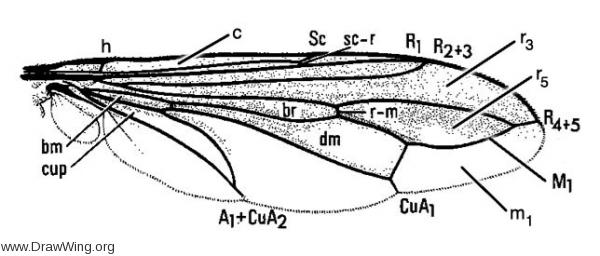
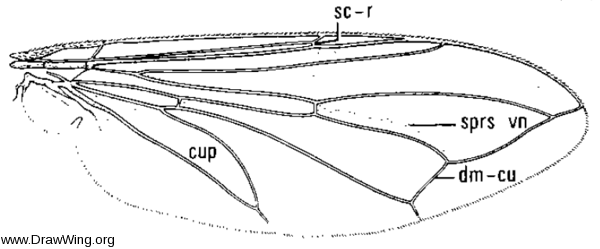
Wing Venation In Physocephala, the anterior crossvein (denoted "r-m" in the diagram below), is located well beyond the middle of discal cell (denoted "dm"); and the discal cell is strongly "indented" just basad of the crossvien r-m. Note that the tiny crossvein bounding the discal cell at its base is usually hard to see, but it is always just beyond where the vein on the lower edge of the discal cell meets cell "cup" (cf. 2nd diagram below):
In Physoconops, the crossvein r-m is near or before the middle of cell dm; and the discal cell is typically less strongly indented basad of crossvein r-m, and often more-or-less straight along its upper edge:
Hind femora In Physocephala the the hind femur is irregularly thickened and widest in its basal portion:
In Physoconops, the hind femur has a more uniform thickness and is widest near the middle:
Note that the hind femur character is best employed with a profile view. From some angles the basal swelling in Physocephala may not be clearly apparent.
To be confident of an identification, it's best to have a number of characters available for verification, since some may be difficult to interpret (or even "not work", due to variation), or they may not be visible. While the above characters are the primary ones used to separate Physocephala and Physoconops in most keys, and are presumably the most consistent and dependable ones, the following additional characters are also useful in distinguishing these two genera:
1) Physocephala do not have ocelli, whereas Physoconops have very small ocelli located on a swelling at the vertex(5) [see comment here by Jeff Skevington]. 2) Most (nearctic) Physocephala have a sharply defined "T"-shaped marking on the frons, most Physoconops do not. 3) In Physoconops the last few tarsi on all legs are typically dark black and the pulvilli are large and yellow; whereas in Physocephala the tarsi are typically narrower, lighter reddish or yellowish, and the pulvilli and darker (with little or no yellow) and typically smaller. 4) In some (but not all!) Physoconops the 3rd antennal segment is noticeably much longer than it is in Physocephala. 5) In some (but not all!) Physoconops the female's theca is noticeably much longer than it is in Physocephala. Print References Bohart, George E., & J. W. MacSwain (1939). The life history of the sand wasp, Bembix occidentalis beutenmuelleti Fox and its parasites. Bull. So. Calif. Acad. Sci., 38(2):84-97 ( Full Text)
Bohart, George E. (1940). A record of Physocephala affinis Williston as a parasite of adult Bembix comata Parker. Pan-Pacific Entomologist, 16(1):16 ( Full Text)
Bohart, George E. (1941). A review of the genus Physocephala of the western United States (Diptera, Conopidae). Pan-Pacific Entomologist, 17(3):141-144 ( Full Text)
Camras S. (1957) A review of the New World Physocephala (Diptera: Conopidae). Ann. Ent. Soc. Am. 50:213-218.
Camras S. (1996) New information on the New World Physocephala (Diptera: Conopidae). Ent. News 107: 104-112 ( Full text)
Camras, S. and P. D. Hurd (1957). The Conopid Flies of California. Bull. Calif. Insect Surv. 6(2):19-50. ( Full Text)
Gibson, J.F., Slatosky, A.D., Malfi, R.L., Roulston, T., & Davis, S.E. (2014). Eclosion of Physocephala tibialis (Say) (Diptera): Conopidae) from a Bombus (Apidae: Hymenoptera) host: A video record J. ent. Soc. Ont. Volume 145: 49-58. ( Full text)
Malfi, R. L. & J. A. Walter, T. H. Roulston, C. Stuligross, S. McIntosh, & L. Bauer (2018). The influence of conopid flies on bumble bee colony productivity under different food resource conditions. Ecological Monographs, 88(4):653-671 ( Abstract)
Otterstatter M.C., Whidden T.L., Owen R.E. (2002) Contrasting frequencies of parasitism and host mortality among phorid and conopid parasitoids of bumble-bees. Ecol. Entomol. 27(2): 229-237.
Parsons, C. T. (1948). A Classification of North American Conopidae. Ann. Ent. Soc. Am., Vol. 41, No. 2, pp. 223-246 ( Full Text)
Van Duzee, M. C. (1927). A contribution to our knowledge of the North American Conopidae (Diptera). Proc. Cal. Acad. Sci., Vol. 16, pp. 573-604 ( Full Text...see pg. 579- 583 for Physocephala)
Van Duzee, M. C. (1934). Conopidae from North Dakota and the Rocky Mountain region. Ann. Ent. Soc. Amer., 27:315-323 ( Full Text)
Williston, S. W. (1882). The North American species of Conops. Trans. Conn. Acad. Arts & Sci., 4:325-342 ( Full Text)
Williston, S. W. (1885). North American Conopidae. Trans. Conn. Acad. Arts & Sci., 6:391 ( Full Text) Internet References Revista Brasileira de Entomologia. Larval development of Physocephala (Diptera, Conopidae) in the bumble bee Bombus morio (Hymenoptera, Apidae) Works Cited | 2. | Conopid Flies (Diptera: Conopidae) Parasitizing Centris (Heterocentris) analis (Fabricius) (Hymenoptera: Apidae, Centridini)
Alex M. Santos, José C. Serrano, Ricardo M. Couto, Leonardo S.G. Rocha, Cátia A. Mello-Patiu and Carlos A. Garófalo. 2008. Neotropical Entomology, v.37, n.5, p.606-608. | |
| 3. | The Conopid Flies of California
Sidney Camras and Paul D. Hurd, Jr. 1957. University of California Press. | |
| 5. | Manual of Nearctic Diptera Volume 2
Varies for each chapter; edited by J.F. McAlpine, B.V. Petersen, G.E. Shewell, H.J. Teskey, J.R. Vockeroth, D.M. Wood. 1987. Research Branch Agriculture Canada. | |
|
|

|
|